12 Best Marketing Campaigns, Judged on Money
 My short answer
My 12 best marketing campaigns, judged on what they bought: Apple's 1984, Just Do It, the meerkats, Snickers, Dove Sketches, Zain's Ramadan films, Whopper Detour, Michael CeraVe, Duo's death, AXA's Three Words, Spotify Wrapped and Suncorp Haven. The ones that lasted bought a habit or a moment, not reach.
Every year someone publishes a list of the best marketing campaigns, and it’s mostly the same famous advertisements. Dove, Nike, Apple, a meerkat. You’ve read it. It doesn’t tell you what to do on Monday.
I buy media for a living, so I judge the best marketing campaigns on money. What did each one actually buy? What did it cost? And is the same thing still for sale in 2026?
Here are 12 marketing campaign examples, 7 famous and 5 recent.
What the best marketing campaigns actually bought
The best marketing campaigns bought something that kept paying after the media stopped. A name people type straight into a browser. A moment the brand owns in memory. A habit inside a product. Everything else is rented attention, and rented attention disappears the same week the budget does.
So I run every campaign through 3 tests:
- Direct demand: people search your name instead of your category. It’s the cheapest traffic there is.
- An owned occasion: hunger, Ramadan, the end of the year. If the brand is the default answer to a moment, the moment does the selling.
- A distribution habit: the campaign lives inside the product, so users carry it for free.
Clever marketing campaigns get shared. Popular marketing campaigns get remembered. Successful marketing campaigns leave one of these behind.
Rented, stops when the budget does
- Reach bought in a burst
- One film, one flight
- Awards and case study coverage
- Cost per point rises every year
Owned, keeps paying afterwards
- People typing your name, not the category
- A purchase moment held for years
- Distribution built into the product
- Cheaper traffic in year three
Famous marketing campaigns that still hold up
Of the best marketing campaigns of all time, these are the 7 I’d still put in front of a brand today. Each bought something specific, from a launch to app installs. A couple could be bought again now. Most couldn’t, not at the same price.
Apple “1984” (1984)
- What they did: a Ridley Scott film for the Macintosh launch, made by Chiat/Day. It ran nationally once, in Super Bowl XVIII on 22 January 1984.
- What it bought: a launch moment the whole country watched at once, then decades of free replays. It’s on most lists of the best advertisements of all time.
- Why it worked: 1 slot, 1 audience, 1 idea, and a board that didn’t like it.
- Would it work in 2026: partly. The Super Bowl still buys a whole country at once. Running it only once is the part nobody copies.
Nike “Just Do It” (1988)
- What they did: a line that first ran in a July 1988 Wieden+Kennedy spot with Walt Stack, an 80 year old who ran 17 miles every morning.
- What it bought: a line Nike could keep for decades. Its 30th anniversary film, “Dream Crazy” with Colin Kaepernick, won the 2019 Emmy for Outstanding Commercial.
- Why it worked: it’s about the buyer, not the shoe, so it fits any sport, any athlete and any year.
- Would it work in 2026: yes. It’s one of the best brand campaign examples: a line is the cheapest asset to keep and the dearest to replace.
Compare the Market meerkats (2009)
- What they did: VCCP built Aleksandr Orlov, a meerkat tired of people confusing comparethemeerkat.com with comparethemarket.com.
- What it bought: brand search. The trade story is that it was built to cut search costs in a price inflated category. Some planners think that story came afterwards.
- Why it worked: either way, it moved people off a crowded category word onto the brand’s own name. Media arbitrage dressed up as a creative idea.
- Would it work in 2026: partly. Brand search is still the cheapest click, but building it takes far more TV now.
Snickers “You’re not you when you’re hungry” (2010)
- What they did: BBDO New York launched it in the first ad break of Super Bowl XLIV, with Betty White getting tackled at football.
- What it bought: a physical state. Hunger is the purchase moment, and Snickers is the answer to it. The line has run in more than 80 countries since.
- Why it worked: the same idea every year, so each new ad tops up the old memory.
- Would it work in 2026: yes, if you commit. Most brands relaunch every 12 months, which costs more and builds less.
Dove “Real Beauty Sketches” (2013)
- What they did: a forensic artist drew women from their own description, then from a stranger’s. The strangers’ versions were kinder and more accurate.
- What it bought: reach Dove didn’t pay for. Unilever said it passed 114 million views in under a month, the most viewed online video ad at the time. It won the Titanium Grand Prix at Cannes in 2013.
- Why it worked: it sat on a position Dove had held for years.
- Would it work in 2026: the film, no. One long video doesn’t travel like that in today’s feeds. The position, yes.
Zain’s Ramadan films (every Ramadan)
- What they did: the Kuwaiti operator releases one big film each Ramadan, on TV across the region and on YouTube. The 2020 film passed 12 million YouTube views in its first week.
- What it bought: a date on the calendar. Ramadan in MENA isn’t a seasonal lift, it’s the season, and Zain turns up every year.
- Why it worked: every big advertiser buys the same weeks, so Zain competes on the film and lets the pickup do the reach.
- Would it work in 2026: yes, in MENA. The risk is the topic. The 2017 film drew real criticism alongside the praise, which I cover in controversial ads.
Burger King “Whopper Detour” (2018)
- What they did: the Burger King app offered a Whopper for 1 cent, but the coupon only unlocked when you were at a McDonald’s. FCB New York made it.
- What it bought: app installs. Burger King put it at 1.5 million downloads. It won the Titanium Grand Prix at Cannes in 2019.
- Why it worked: the media was a competitor’s car park, and it was free. The cost was a coupon.
- Would it work in 2026: yes. It’s the cleanest advertising campaign example I know of a price promotion doing a brand’s job.
Recent marketing campaigns, 2024 to 2026
The recent marketing campaigns worth studying have one thing in common: most of them aren’t ads in the old sense. They’re a social stunt, a product change, a data tool or a feature users share themselves. That’s where the most innovative marketing campaigns of 2025 and 2026 put their money.
CeraVe “Michael CeraVe” (2024)
- What they did: before CeraVe’s first Super Bowl ad, Ogilvy PR seeded a rumour through creators that Michael Cera had invented the moisturiser. The ad in Super Bowl LVIII paid it off.
- What it bought: weeks of free talk around one paid slot. It won the Social and Influencer Grand Prix at Cannes in 2024.
- Why it worked: the spot was the punchline. Creators did the reach before the expensive airtime ran.
- Would it work in 2026: yes. It makes a Super Bowl slot work for weeks instead of one ad break.
Duolingo, the death of Duo (2025)
- What they did: on 11 February 2025, Duolingo said its owl was dead (hit by a Cybertruck, fans later learned). 2 weeks later, Duo came back.
- What it bought: attention at almost no media cost. Duolingo told Fast Company it got 1.7 billion impressions on its own accounts in 2 weeks, against a goal of 70 million.
- Why it worked: Duolingo had spent years building a mascot people already talked about, so a 6 day production could ride it.
- Would it work in 2026: only for Duolingo. It said the stunt drove “a meaningful lift” in new and returning users, without a number.
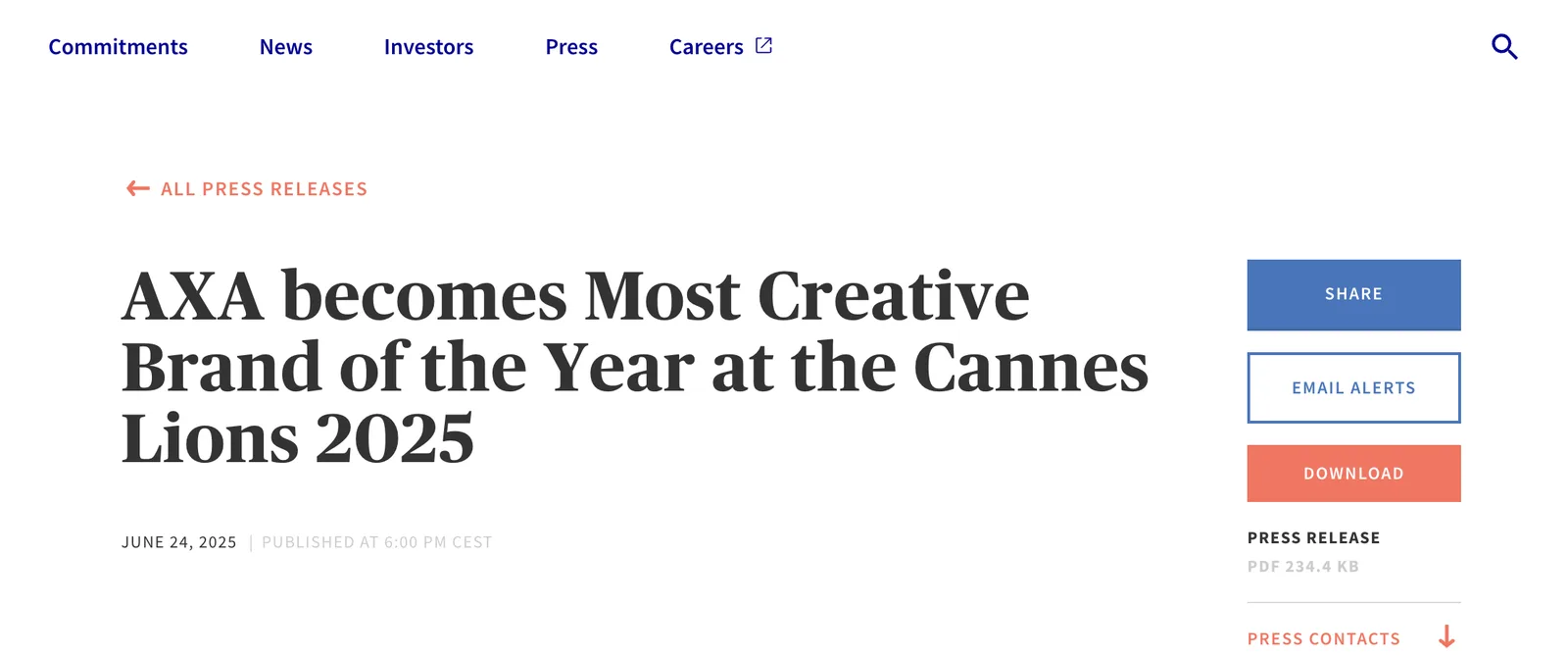
AXA “Three Words” (2025)
- What they did: AXA France added “and domestic violence” to its home insurance contracts, so emergency rehousing for fire or flood now covers people leaving an abusive home.
- What it bought: a product difference written into the contract. AXA says it won 10 Lions, including the Titanium Grand Prix.
- Why it worked: the campaign is the product change. The policy wording is the claim.
- Would it work in 2026: yes, and it’s the hardest to copy: it needs the legal team, not the agency.
Spotify Wrapped (2025)
- What they did: the yearly recap of each user’s listening, built from their own data and made to be posted.
- What it bought: distribution by users. Spotify said the 2025 edition passed 200 million engaged users in its first 24 hours and was shared more than 500 million times.
- Why it worked: the product makes the creative, the user posts it and the feed carries it.
- Would it work in 2026: only if you own the data and the app. It’s still the best of the digital campaign examples here.
Suncorp “Haven” (2026)
- What they did: the Australian insurer launched a tool in May 2025 for all Australians, not just customers. Type an address, get a video and a report on that home’s storm, bushfire, cyclone and flood risk.
- What it bought: a visit to an insurer before anyone has a claim. It won the Titanium Grand Prix at Cannes in 2026.
- Why it worked: it’s useful. People avoid thinking about insurance, and Haven gives them a reason to.
- Would it work in 2026: yes, for any brand with data its customers would find useful.
Best ad campaigns side by side
Here are the 12 best ad campaigns from this list next to each other. The column that matters is the last one. A campaign budget isn’t the interesting number. Whether the thing it bought is still for sale, at a price a normal brand can pay, is.
| Campaign | Year | What it bought | Still works in 2026 |
|---|---|---|---|
| Apple “1984” | 1984 | A national launch moment | Partly, the Super Bowl still exists |
| Nike “Just Do It” | 1988 | A line for decades | Yes |
| Compare the Market | 2009 | Brand search | Partly, at a much higher cost |
| Snickers hunger line | 2010 | A purchase moment | Yes, if you commit for years |
| Dove Sketches | 2013 | Unpaid reach | No, the feed changed |
| Zain Ramadan films | Yearly | A date on the calendar | Yes, in MENA |
| Whopper Detour | 2018 | App installs | Yes |
| Michael CeraVe | 2024 | Talk around 1 paid slot | Yes |
| Death of Duo | 2025 | Attention from a mascot | No, unless you built the mascot first |
| AXA “Three Words” | 2025 | A product difference | Yes, with a legal team |
| Spotify Wrapped | 2025 | Distribution by users | Partly, only if you own the data |
| Suncorp Haven | 2026 | A reason to visit | Yes |
The best marketing campaigns on it are the oldest lines, not the most iconic ads.
Award winning and profitable aren’t the same thing
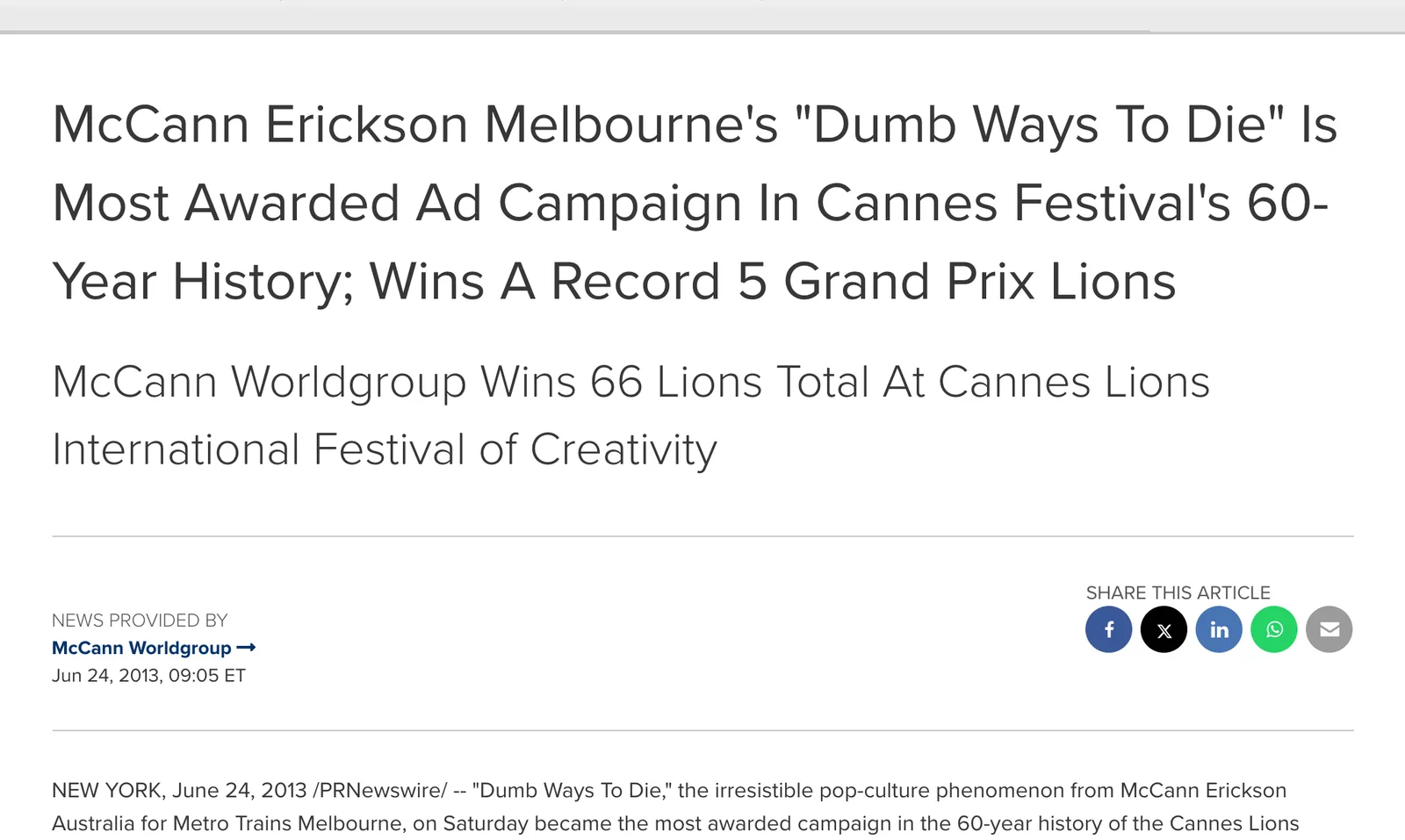
Dumb Ways to Die left Cannes in 2013 as the most awarded campaign in the festival’s 60 year history, and it isn’t on my 12. It won 5 Grand Prix, 18 Gold, 3 Silver and 2 Bronze Lions and passed 50 million YouTube views. The strongest claims about train safety came from the people who made it.
It’s a great film, and it’s on plenty of lists of the best marketing campaigns. It shows a gap in how the industry reports itself:
- A jury judges: craft, originality and the case film.
- A finance director judges: incremental margin against what would have happened anyway.
Juries reward unique marketing campaigns. Finance directors reward repeatable ones.
You can read the official Cannes result and then try to find an equally solid number for sales or safety.
So when someone pitches you one of the best marketing campaigns they’ve ever made, ask 3 things:
- Which number moves: brand search, sales, installs or sign ups.
- By when: a date, not “over time”.
- Against what: what would have happened if you’d spent nothing.
If the answer comes without a figure, the pitch is for the agency’s reel, not your account.
Why most famous ad campaigns would struggle in 2026
Most famous ad campaigns would struggle today because the audience they bought doesn’t sit in one place any more. In May 2026, streaming took 48.6% of US TV time, against 20.4% for cable and 19.2% for broadcast. Buying a country in one week used to be a media plan. Now it’s procurement across a dozen sellers.
The Nielsen Gauge for May 2026 is worth reading in full. 3 things follow from it for anyone planning an ad campaign:
- Reach costs more per point: the same rating points now come from more sellers and more contracts.
- Frequency is harder to control than to buy: finding the same person across streaming, social and the open web is the real job, and most plans skip it.
- One film is a weaker asset: feeds reward volume and variation, so 15 decent versions beat 1 perfect one.
The exception is the Snickers pattern: consistency survives fragmentation, because memory is the one channel nobody has unbundled.
What I’d take from the best marketing campaigns
The lesson from the best marketing campaigns is structural, not creative. Pick one moment, say one thing about it, and keep saying it long enough to become the default answer. Or build something people use and let them share it. Both survive a fragmented media market. A single brilliant film mostly doesn’t.
Here’s what copying the best marketing campaigns looks like on a normal budget:
- No Super Bowl money: copy the mechanic, not the film. Own one purchase moment every year. In the Gulf, that’s often Ramadan.
- A product people use: look for your Wrapped. What could users post about themselves?
- A competitor nearby: Whopper Detour cost a coupon and a geofence.
That’s the thinking under my media buying work, and why I argue about creative volume before targeting.
Not sure a campaign is even the right shape for your budget? Talk to me.
Questions people actually ask
What are the most successful marketing campaigns of all time?
On money, my picks are Nike's Just Do It, Snickers' hunger line and Compare the Market's meerkats, because each one bought something that kept paying for years: a line, a purchase moment and brand search. Apple's 1984 and Dove's Real Beauty Sketches are more famous examples of marketing campaigns, but they bought one huge moment rather than a lasting asset.
What do successful marketing campaign examples have in common?
They buy something that keeps working after the media stops. Good marketing campaigns usually leave 1 of 3 things behind: people searching the brand name instead of the category, a purchase moment the brand owns, or a habit inside the product. Reach on its own is rented, and it ends the week you stop paying.
Are award winning campaigns usually profitable?
Often nobody knows, and the two get confused all the time. Juries judge craft, originality and the case film. Profit is judged on incremental sales against what would have happened anyway. Dumb Ways to Die is one of the most awarded campaigns in Cannes history, and its effect on train safety is still argued over. Ask for the payback number.
How much did famous ad campaigns cost?
Almost nobody publishes the real figure, and the numbers that circulate usually come from the agency that made the work. The shape of the spend is more useful. Apple's 1984 paid for 1 national Super Bowl slot. Snickers spreads one line over 15 years and more than 80 countries. A viral film is cheap to make and hard to repeat.
What are some recent ads worth studying?
From 2024 to 2026: CeraVe's Michael CeraVe Super Bowl tease, Duolingo killing off its owl, AXA's Three Words, Spotify Wrapped and Suncorp's Haven. Most of these recent ad campaigns aren't ads in the old sense. They're a stunt, a product change or a tool, which is why the cool marketing campaigns now come out of product teams as often as agencies.
Which Gulf campaigns are worth studying?
Zain's Ramadan films are the clearest example in the region. One big film a year, released into the moment Arab households watch together, on TV across MENA and on YouTube. The 2020 film passed 12 million YouTube views in its first week. The mechanic is owning a date on the calendar, every year, not buying it once.