Programmatic advertising explained: what you're buying
 My short answer
Programmatic advertising is software buying ad space from software, one impression at a time, in an auction that ends in a fraction of a second. What you're buying is 1 of 4 deal types, from open auction to programmatic guaranteed. On the ANA's log level data, only 36 cents of each DSP dollar reached a consumer.
Most people nod along when someone says programmatic advertising, and I don’t blame them. The same word covers a $2 CPM impression on a site you’ve never heard of and a six figure guaranteed deal with a named publisher.
The gap between those 2 things is the whole problem.
Someone tells you they’ll “run programmatic” for you. That sentence fits 4 different products, 3 different fee structures and a tenfold difference in how much control you get. Worth knowing which one is in the proposal.
What programmatic advertising means
What is programmatic advertising? Here’s the plain programmatic advertising definition: software buys ad space from software, one impression at a time, in an auction that’s over before the page finishes loading. No phone call, no insertion order. The programmatic meaning is literal. A program does the buying, inside rules and a budget a person set.
If I had to explain programmatic advertising to a client in one line, I’d call it a stock exchange for ad slots. People also say programmatic marketing or programmatic media buying. Same thing.
Strip the jargon and the programmatic definition has 3 parts:
- Automated: software places the bid, not a person.
- Per impression: you pay for one person seeing one ad, priced in the moment.
- Rules based: a person sets the audience, the sites, the price ceiling and the budget. The software works inside them.
The grammar it all runs on is the IAB Tech Lab’s OpenRTB specification, currently version 2.6. And it’s how most display gets bought now: around 90 percent of US digital display spend, on EMARKETER’s numbers.
The important part is what it didn’t replace. The auction decides the price. It doesn’t decide whether the page your ad landed on has a human reading it.
How programmatic buying works, step by step
How does programmatic advertising work? A person loads a page, the page asks for an ad, every buyer with a seat bids, the highest bid wins and the ad shows. The whole exchange takes roughly 100 to 300 milliseconds. Here’s the programmatic buying chain in 6 steps, from the page load to the ad on screen:
- A page loads. Someone opens an article, an app or a connected TV app with an ad slot in it.
- The publisher’s SSP sends a bid request. It describes the slot, the site, the device and whatever it knows about the visitor.
- The exchange passes it on. Every DSP with a seat sees the same request at the same time.
- Each DSP decides. It checks your targeting, your blocklist and your bid rules, then bids or passes.
- The highest bid wins. This is the real time bidding part: the exchange tells the winner and sets the price.
- The ad renders and the impression is logged. Verification tools check it was a real page and a real view, and your reporting picks it up.
Programmatic ad buying swapped a phone call and an insertion order for that loop. It runs on every impression, and nobody watches any single one of them.
The programmatic platforms: DSP, SSP and exchange
There are 3 kinds of software between your budget and the page. A demand side platform buys for advertisers. A supply side platform sells for publishers. An ad exchange is where the 2 meet. Every programmatic advertising platform you get pitched is 1 of these, or a service wrapped around one.
- DSP (demand side platform): the buy side. It’s the DSP programmatic buyers log into to set targeting, bids and budgets. The Trade Desk, Google’s Display & Video 360 and Amazon DSP are the programmatic advertising companies you’ll hear named most.
- SSP (supply side platform): the sell side. It packages a publisher’s slots and sets the floor prices.
- Ad exchange: where bid requests and bids meet. Many SSPs run their own.
- Data and verification: audience segments you rent, and tools that check an impression was real and viewable. Each one is a line on the invoice.
Most programmatic advertising solutions you’ll be offered are a DSP seat with people on top. A programmatic agency, or the DSP’s own managed service, runs the seat for you. Agencies usually charge a share of spend, a retainer or a flat fee, on top of the platform’s own cut.
Ask who owns the seat, and whether you can log in and see it.
The newer pitch is AI programmatic advertising. Most of it is the bid model a DSP already runs, with a new label. It sets the price well. It still doesn’t pick your sites for you.
The 4 deal types sold as programmatic
Open auction, private marketplace, preferred deal and programmatic guaranteed. An open auction lets any buyer with a seat bid on the impression. A private marketplace limits it to an invited list at a higher floor. A preferred deal fixes your price and gives you first look. Programmatic guaranteed commits volume, like a direct buy with a pipe attached.
The difference between them is who sees the impression first, and how much you know about where it went.
| Deal type | Who can bid | Price | What you control | When it makes sense |
|---|---|---|---|---|
| Open auction | Anyone with a DSP seat | Lowest CPM | Almost nothing beyond blocklists | Broad reach, tolerant of waste |
| Private marketplace | An invited list, by deal ID | Higher floor | The publisher list, roughly | You care where the ad ran |
| Preferred deal | You, at a fixed price, first refusal | Fixed | Inventory and price, not volume | Repeatable placements on a few sites |
| Programmatic guaranteed | You only, volume committed | Highest | Everything, like a direct buy | Sponsorships, launches, CTV |
Most agencies quoting you a cheap CPM are quoting open auction. Most brands who feel burned by programmatic were buying open auction and thought they were buying the fourth row.
Open auction, lowest CPM
- Any buyer with a DSP seat bids
- Price set in about 100 to 300ms
- You get blocklists, not a site list
- Where the made for advertising waste sits
Programmatic guaranteed, highest CPM
- One buyer, volume committed up front
- Fixed price agreed with the publisher
- You know the site before it runs
- Behaves like a direct buy on rails
Where the money goes
This is the part nobody in the supply chain volunteers. The ANA studied log level data from 21 large advertisers, on campaigns run from September 2022 to January 2023, and published it in December 2023. Its finding: only 36 cents of every dollar entering a demand side platform reached a consumer.
On a programmatic buy, the rest goes in stages:
- DSP fee: the platform’s cut for bidding on your side.
- SSP fee: the same cut on the publisher’s side.
- Data fees: for the audience segment you targeted.
- Verification fees: to check the impression was real.
- Waste that isn’t a fee at all: impressions that were served and viewable, on sites built for nothing but absorbing ad budget.
The ANA put those made for advertising sites at 21 percent of impressions and 15 percent of spend. The average campaign in the study ran across 44,000 domains. Nobody chose 44,000 domains. An algorithm did, because nobody told it not to.
2 industry files help, and both are free to check:
- ads.txt: sits on a publisher’s domain and lists who’s authorised to sell its inventory.
- sellers.json: sits on an exchange and names the seller behind each seat.
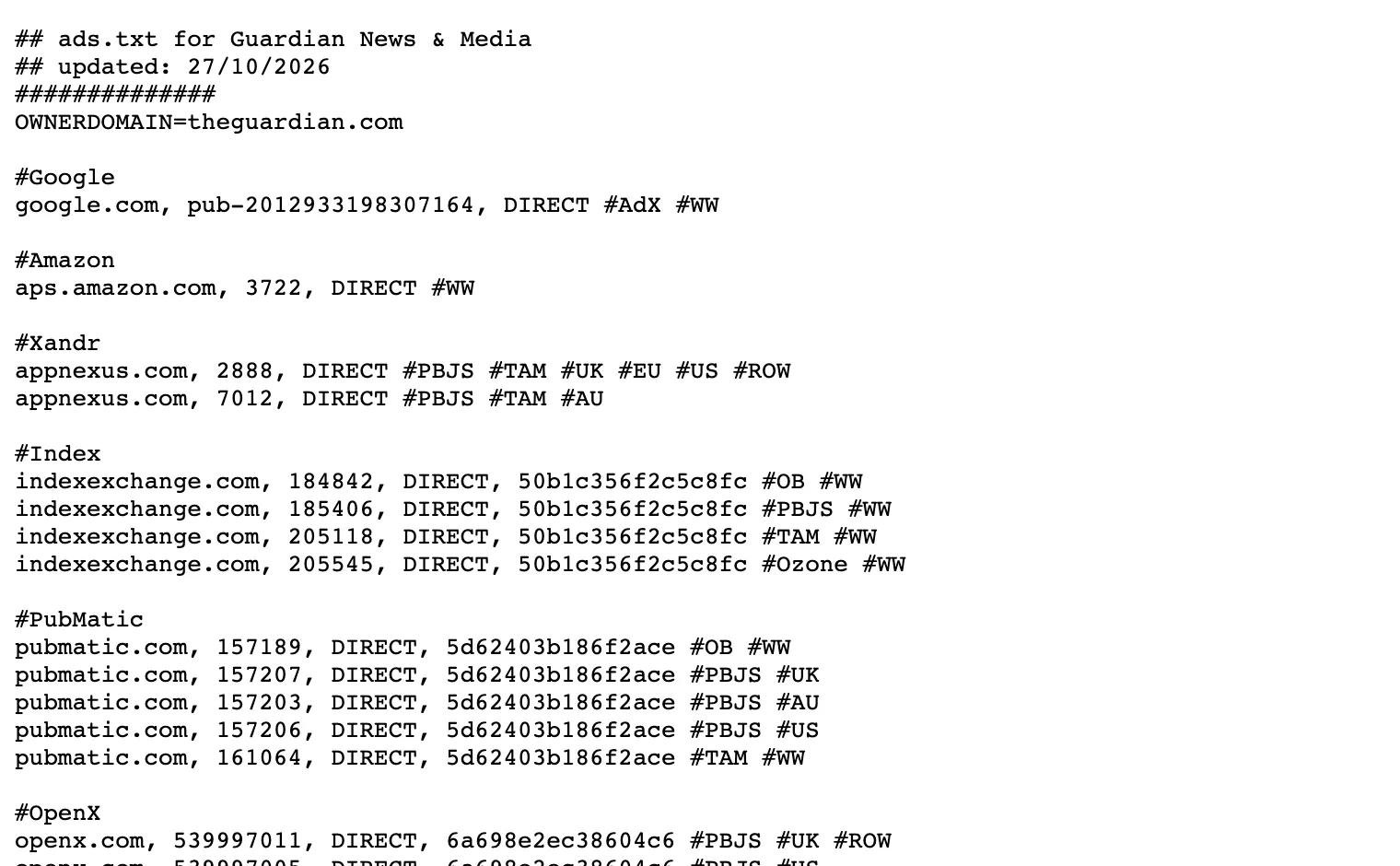
Together they show how many hops sit between your bid and the page. Every hop is a fee.
The buy side name for cleaning this up is supply path optimisation. It sounds like consultancy and it’s mostly arithmetic: pick the shortest authorised path to each publisher you care about, and cut the rest. On a mid sized account, that alone is usually worth more than a month of bid tuning.
Programmatic display advertising, and where the growth is
Programmatic display advertising on the open web is what most people mean when they complain, and it’s growing slowest. IAB and PwC put US display at $81.6 billion for 2025, up 9.8 percent. Social reached $117.7 billion, up 32.6 percent, and commerce media $63.4 billion, up 18 percent.
The same report put programmatic revenue across all formats at $162.4 billion, up 20.5 percent. So the money’s still moving into programmatic. It’s just moving away from the banner.
The growth sits where there was never a cookie problem. All 3 of these are bought programmatically, and none needs a third party identifier:
- Connected TV: the same auction, with a household and a device graph instead of a browser cookie.
- Retail media: sold against a logged in purchase history.
- Digital out of home: sold against a location and a time of day.
That’s the shift worth planning around in the Gulf. Connected TV inventory in Saudi Arabia and the UAE is now sold with the same deal IDs as web display. Retail media on the large regional marketplaces is often a cleaner buy than open exchange supply.
Why programmatic got harder to measure
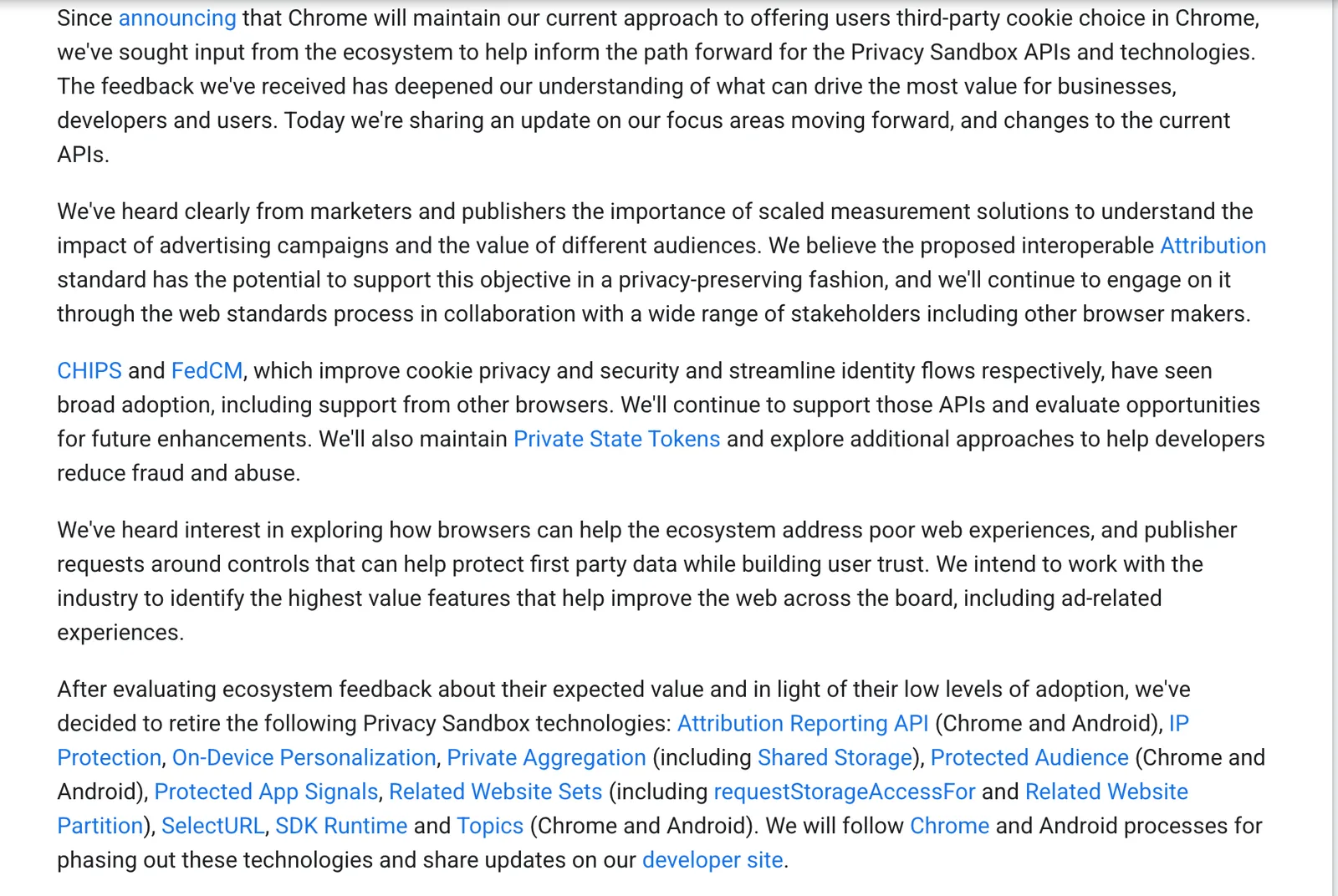
Third party cookies didn’t die, so that’s not the reason. Google said in April 2025 that Chrome would keep them, with no new prompt, then retired most of the Privacy Sandbox in October 2025. What you have instead is a split by browser, and it makes frequency capping and reach reporting on the open web unreliable.
The story you’ve probably heard is that cookies died and took targeting with them. Repeating it in 2026 marks you out.
Google’s October 2025 update retired 10 Privacy Sandbox technologies, including Topics, Protected Audience and the Attribution Reporting API. So there’s no cookie replacement, and no cookie deprecation either.
On StatCounter’s October 2026 numbers, Chrome is about 69 percent of global browsing and still accepts third party cookies. Safari at about 17 percent and Firefox at about 3 percent have blocked them by default for years.
So about a fifth of browsing has been unaddressable by cookie the whole time. Your reach and frequency reports have been quietly wrong about it.
Targeting didn’t stop working. Frequency capping across the open web did, so your measurement leans harder on advertisement tracking you own.
And on contextual advertising, which buys against the page instead of the person and needs no identifier at all.
What I’d do
For most brands I talk to, open web programmatic can wait. It’s a scale product, and the fee stack only pays for itself above roughly $20,000 a month. Below that, Google Ads Display buys much of the same inventory with no seat fee, no minimum spend and one less party taking a cut.
The programmatic advertising benefits are real once you’re past that line:
- Reach: one buy across thousands of publishers, plus connected TV and digital out of home.
- Control: deal IDs, allowlists and frequency caps by household.
- Data: log level reporting on every impression, if you ask for it.
Below that line you’re paying a DSP fee, a data fee and a management fee to reach inventory you could have bought more directly.
If you hire a programmatic advertising agency, or buy a managed service from the DSP itself, insist on 3 things:
- A domain allowlist, not a blocklist. A few hundred sites will reach most of your audience. Start there and expand, instead of starting at 44,000 and pruning.
- Log level or placement level reporting, monthly. If a partner won’t show you where the impressions ran, that’s your answer.
- The fee stack written down. Media cost, DSP fee, data fee, verification fee, agency fee. 5 numbers. A partner who gives you 1 blended number is hiding at least 1 of them.
The same goes for media buying in general. A blended number is a number designed not to be checked.
Past the line and ready to test? Here’s how I’d set up a first programmatic campaign:
- Own the seat. If you buy programmatic advertising services from an agency, the DSP account should still be in your name, so the data stays with you if the agency goes.
- Start with private marketplace deals on your allowlist. You pay a higher floor and you know where every ad ran.
- Set a frequency cap from day 1. Per household on connected TV, per device on the web, knowing the web cap leaks on Safari.
- Hold out a region. Run it for 8 weeks against a market with no programmatic, so you can see what it added, not just what it touched.
- Benchmark it against Google Ads Display on the same budget. If the DSP can’t beat it, you have your answer.
I run programmatic when the budget justifies it, as one channel next to search, social and retail media. Under $20,000 a month, the money usually does more work in those, where the feedback loop is days instead of weeks.
Not sure programmatic advertising belongs in your plan this year? Talk to me.
Questions people actually ask
What is programmatic marketing?
It's another name for programmatic advertising: buying ad space automatically, one impression at a time, through a demand side platform instead of a person calling a publisher. Programmatic marketing, programmatic media buying and programmatic ads all describe the same auction. If a proposal uses any of them, ask which deal types and which DSP sit behind the word.
What are programmatic ads? Any examples?
Programmatic ads are any ads bought through that automated auction, whatever the format. Programmatic advertising examples you've already seen: a banner on a news site that matches something you browsed, a pre roll before a video on a publisher's site, an ad inside a connected TV app, and a digital billboard that changes by time of day. Same pipe, different screens.
Is programmatic advertising the same as display advertising?
No. Display is a format, a banner or a rich media unit on a web page. Programmatic is a buying method, an automated auction. You can buy display programmatically, and you can buy video, audio, connected TV and digital billboards the same way. Almost all display is now bought programmatically, which is why the 2 words get used as if they mean one thing.
What is the difference between an open auction and a private marketplace?
An open auction is available to any buyer with a seat on a demand side platform, and inventory quality varies wildly. A private marketplace is a deal ID a publisher gives to a named list of buyers, usually at a higher floor price, on inventory the publisher has agreed to make available. You pay more per thousand impressions and you know where the ad ran.
How much does a programmatic campaign cost to run?
Open web CPMs sit roughly between $2 and $12 depending on market, format and targeting, and connected TV runs far higher. On top of the media you pay a demand side platform fee, often 10 to 20 percent, plus data and verification fees. Ask any partner to show you the media cost and the fee stack as separate lines before you sign.
Do I need a demand side platform, or can I use Google Ads?
Google Ads Display buys a subset of the same inventory with no seat fee and no minimum spend, so start there. A programmatic DSP makes sense once you need private marketplace deals, connected TV, log level reporting or supply path control. Below roughly $20,000 a month on the open web, a DSP seat costs more in fees and management than it returns.